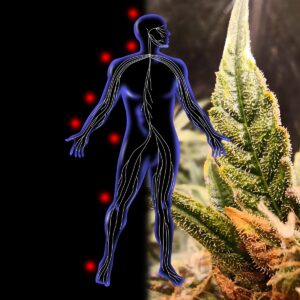
Endocannabinoids are synthesized and act locally in an area where there is a tissue injury, helping to send signals to the brain, pointing out that in that area, there is something wrong. The endocannabinoid system monitors the situation and the tissue. If the affected tissue is healing well and its injury diminishes, the endocannabinoid system adjusts its endocannabinoid production, stopping sending pain signals to the brain. We know that by increasing the activation of CB1 and CB2 receptors, there is a decrease in pain signalling messages.
Clinical trials regarding pain in arthritis, multiple sclerosis and chronic pain have shown that cannabis reduces about 40% of the pain levels.
CBD has been tested on many occasions in its pain relief actions. Topical applications in arthritic joints over a few days demonstrated that inflammation and pain reduced. Similar results were observed when CBD oil is ingested.
Thus, CBD oil allows for correcting an endocannabinoid deficiency and activating cannabinoid receptors to reduce pain signalling messages to the brain.